Women in dairying: from dairymaids to leading scientists
A journey along our library's shelves reveals the changing role of women in dairying and cheesemaking, from the Middle Ages to the present day.
-
Author
- Claudia
-
Published Date
- October 13, 2026

Dairying has traditionally been a female domain, and one of the earliest and most iconic images of a dairymaid in English literature appears in Thomas Tusser’s “Five hundred points of good husbandry ” (1585). This 150-page long rhyming poem helped to establish the genre of agricultural calendars, outlining a farmer’s tasks and rhythms across the year.
Tusser depicts a dairymaid through the character of Cisley. He describes Cisley’s cheesemaking through biblical allusions to 10’ topping guests’ she must avoid, including characters from the Old Testament like Lazard (a cheese too white), Esau (too hairy) and Lot’s wife (too salty). In an appendix to the poem, Tusser states that, in the dairy, the “ill [bad] huswife” should be cured to avoid “houshold a grief / To master and mistress, as ill as a thief”.

Two and a half centuries later, illustrations accompanying a “Technical education for dairymaids” (Graphic, 1892) portray dairymaids at the height of the Victorian era. These take us back to Diderot’s encyclopaedia — an iconic pictorial record of European trades and manufacturing before the Industrial Revolution — but with a crucial difference: dairying is portrayed as a trade in which women carry out most of the tasks while under the watchful eye of a male supervisor. One notable exception is the task of turning the cheeses, a job that requires greater physical strength and thus remains the remit of a man (who is also afforded more practical clothing and a bowler hat!)

Despite the prominence of women’s roles, these images feature anonymous and idealised representations of the archetypical dairymaid, whether shown in long gowns and aprons or framed through Biblical references.
Experiments in the 1890s
It is not until the end of the 19th century that women start to appear in literature as individuals, actively choosing dairy science as a field of study and training, and dairying as a profession that could lead to financial independence. Women from south-west England in particular start to be named and identified, as is the case of Edith Cannon (1868-1963) who lent her name to a cheesemaking method at the turn of the century.
According to Cannon’s biographer Mary Vidal, Edith was already making cheese in her mother’s dairy from the age of 13. She won a prize at the Frome Cheese show in 1887 and continued to win prestigious awards with her prized family recipe for Cheddar. Edith was appointed as the first cheesemaking instructor at an agricultural school opened by the Bath & West Southern Counties Society in the 1880s, where her method was adopted over existing methods (the ‘Candy’ and the ‘Hardy’). Edith’s two younger sisters followed her in the cheese-instructing profession, moving from farm to farm and becoming known as the ‘Cannon cheese-making schools’. The practice came to an end in 1909, but the standards were carried on by the Cannington Farm Institute (founded 1921), now known as Somerset College of Agriculture.
A centre for dairying education in Reading
K.D. Maddever, a Reading alumna and author of the Farmhouse Cheddar Makers’ Manual (1987), was educated at the Cannington Farm Institute before moving to Reading in 1929, where Miss Anne Shepherd and Miss V.E. Cheke ran the Dairy Department.
Maddever went on to become an instructor at Cannington, a trainer for the Women’s Land Army, County Dairying superintendent and eventually County Milk Officer for Somerset and Regional Milk Officer for NAAS (National Agricultural & Advisory Service). These are all roles and institutions that feature prominently in our collections.
Before Maddever’s arrival at Reading, other women had worked to create an environment that was conducive to women’s education within the branches of agriculture that were deemed appropriate to the “gentle sex”. In 1898, Lady Warwick established a group of hostels in Reading to train young women, which later moved to Studley Castle in Warwickshire and developed into a thriving Horticultural & Agricultural College for Women. Our copy of the 1904 issue of the Woman’s agricultural times, the college magazine, lists the recipients of the annual academic awards at Studley College, such as the British Dairy Farmers Association examination, and the dairy prizes, which were celebrated at their annual show.
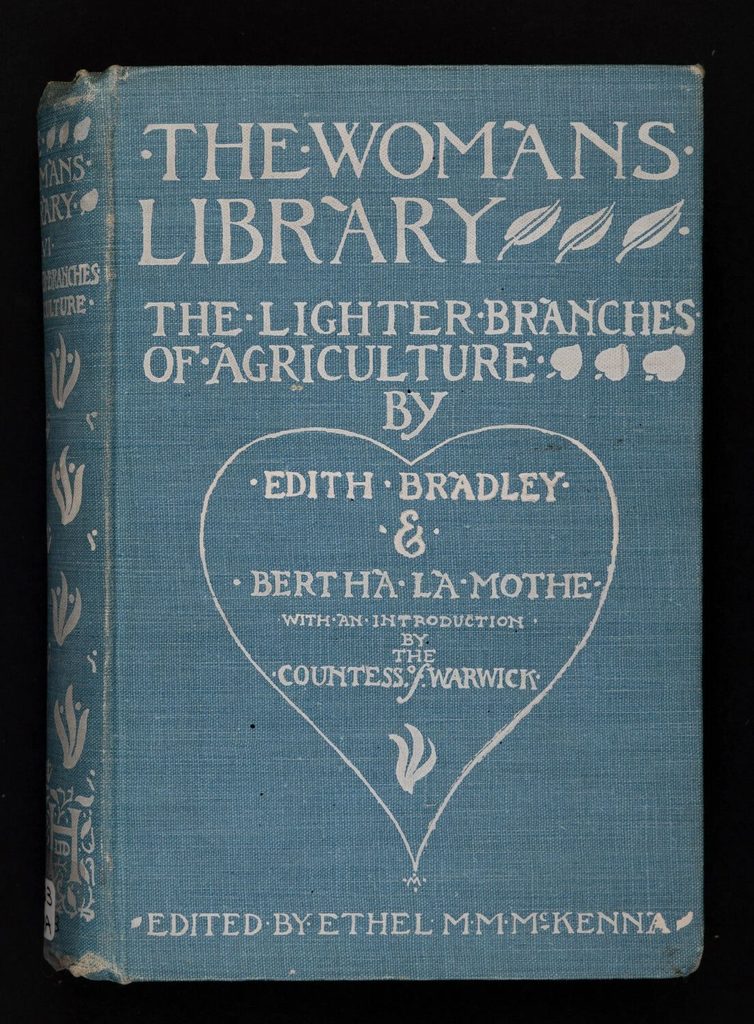
Dairying, together with poultry farming, beekeeping and horticulture, were seen as the “lighter branches of agriculture”, which chimed with the mission of Studley College from its inception, as laid out in the seminal work of two of its founders, Edith Bradley and Bertha La Mothe. The latter was a Women’s Land Army inspector during the First World War and famously said that by the end of the War, ‘no man should be milking a cow.’
Despite the departure of Studley College in 1904, Reading saw its role in dairy education increase and progressively flourish in the years leading up to the First World War and afterwards, as cheese- and butter-making instructions were imparted both at the British Dairy Institute and Reading University College. As Emily K. Little explains in an interview to the Lady’s Pictorial (2/10/1920) under the heading “Women who have made good”:
The War taught us more of the essential value of foodstuffs, and we gave more thought to their production than at any previous time in our history, possibly, so that there is a special interest attaching to such necessary labour as dairy work and the girl, or woman, who feels interested in this occupation will know that she is not only doing good for herself by taking it up, but good, also for the nation at large.
Emily Kyle Little, born in Ireland in 1865, worked as Assistant Instructress at the British Dairy Institute in Reading from 1905 and later as instructress at the University of Reading, retiring unmarried in 1930. There are no publications in her name, but a couple of her own books have entered the collections of our library: The chemistry of cattle feeding and dairying by J. Alan Murray and Practical cheese-making : for smallholders, farmers, and others by Ellen Yeld (5th edition, 1919). Both volumes bear Little’s signature and the bookplate of the St George’s Hall library, where Little had been appointed warden in 1920, when the halls first opened. Following her retirement, she moved in with her sister and died in 1952 as attested by an obituary in the Reading Standard.
Our library also includes a copy of the 2nd edition of Yeld’s Practical cheese-making, featuring the author’s autograph dedication to the Institute for Research in Dairying, which was established at University College Reading (University of Reading today) by the Board of Agriculture in 1912, and was later renamed National Institute for Research in Dairying (NIRD). Its library collections merged with those of the Milk Marketing Board to form the bulk of our library’s Dairy Collection.
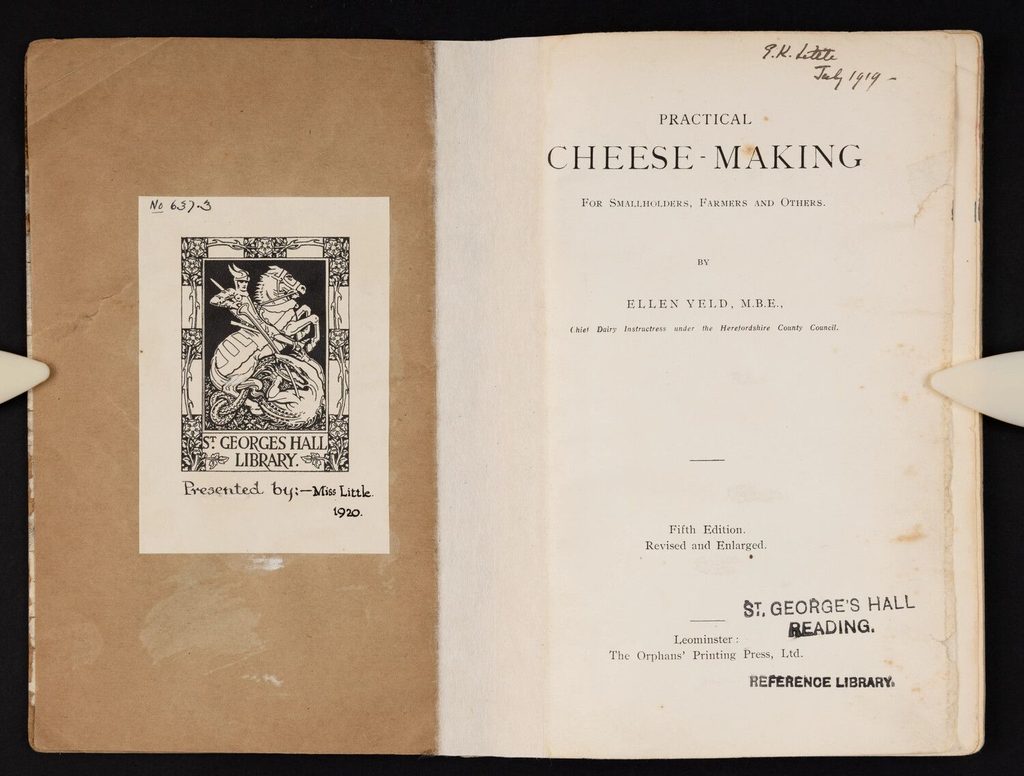
Ellen Yeld MBE (1880-1964) was Chief Dairy Instructress for Herefordshire and invented the recipe of the ‘Little Hereford’. Yeld explains that, in the 1910s, the Board of Agriculture provided impetus to cheesemaking through the County Councils and the travelling cheese schools, which were promoted during the war years as a means to increase food production and make the country less reliant on food imports. The ‘Little Hereford’ is an example of a hard cheese that can be produced in a miniature dairy, hence suitable for women, who have less muscle power.
The Clean Milk campaign
Another book from the same period is Practical Cheddar Cheese-Making by Dora G. Saker (1917), instructress in cheese-making at Somerset County Council. Our copy is inscribed by Kate Boyes, then a student at University College Reading, who went on to become the County Dairy and Poultry Instructress for Oxfordshire.
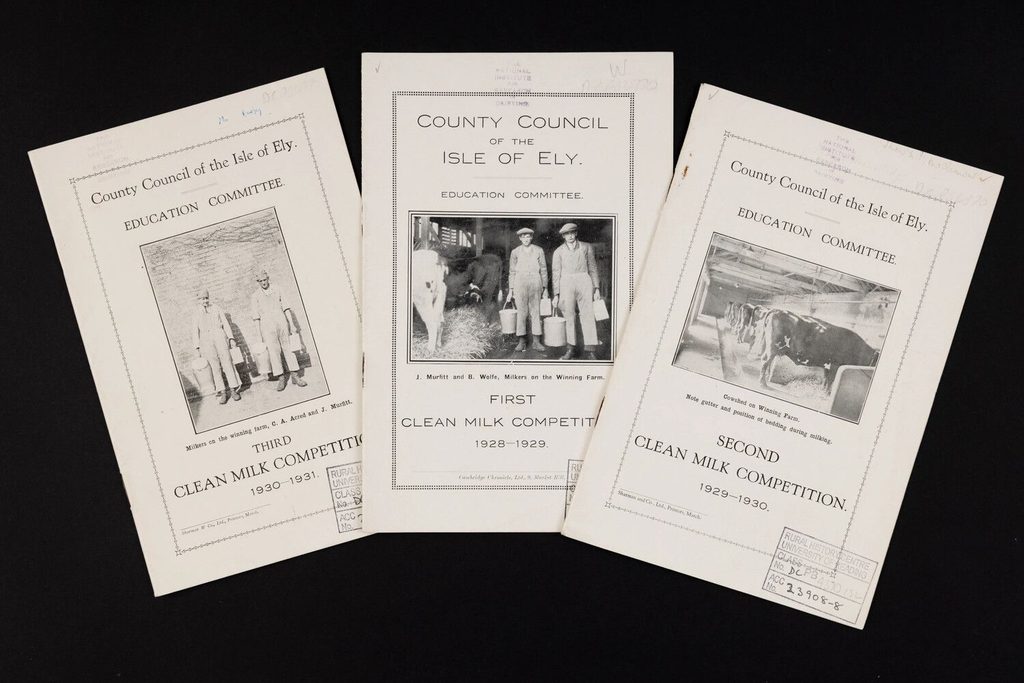
Apart from the numerous commercial advertisements listed in Saker’s book, ranging from the latest “all British” milking machines to “the cheapest” rennet substitutes and butter colouring, the book stands out for its emphasis on hygiene, including advice on how to collect pure milk, and the effect of external factors, such as soil, water supply and cattle feed, on milk. Saker also published Clean milk for cheese making in 1920, again focused on the aspect of hygiene, which must have been a topic in vogue at the time judging by the number of Clean Milk Competitions taking place throughout the country, often featuring women among its contestants and winners.
Val Cheke and her contemporaries
As mentioned above, in her Cheddar Makers Manual, Maddever praises her Reading instructresses, Anne Sheppard MBE (1900-1964 ) and Valerie Essex Cheke (1902-1990), who ran the Dairy Department.
Annie and Val were not just colleagues at the University in the late 1920s and throughout the 1930s, they also shared a house on Reading’s Christchurch Road and volunteered together as air raid wardens during the Second World War.
Sheppard and Cheke co-authored a book, Cheese and butter, published in 1956, and the former is the dedicatee of Val’s seminal work, The story of cheese-making in Britain, (1959), a vast historical excursus that covers all aspects of cheesemaking techniques and traditions in Britain, including the most recent developments in the industry, following the restrictions induced by the war and ensuing Government policies, and in the training of new a generation of ‘Cisleys’.
A contemporary of Val Cheke, Miss Dorothy Vernan Dearden (1884-1965) came to study at Reading from Lancashire, worked as instructress at the British Dairy Institute and the Dairy Department of Reading University until she took charge of an experimental laboratory at the newly founded National Institute for Research in Dairying, in 1927. In 1934 Dearden published an entirely rewritten edition of Practical buttermaking (originally authored by C.W. Walker-Tisdale and Theodore R. Robinson, 1907), which takes proud place on our shelves, but she was also a sewist, leather worker, weaver and gardener and is described as an artistic person in her obituary. As well as featuring in a radio programme in the early 1940s, Dorothy also created costumes for plays at the NIRD, exhibited with the Berkshire Guild of Weavers and had items win at the Shinfield Eisteddfod & Festival.
The annual volumes of the University Calendars list many other women who worked at The Dairy department, the British Dairy Institute and the NIRD during the 20th century and it is impossible to include them all, but a mention should be made of Dr Elfreida C.V. Mattick (1887-1943), one of the first women to be awarded a PhD in Britain (from the University of Bristol in 1924). After a brief spell as teacher and college lecturer, in 1913, Mattick (nee Cornish, also Venn) was awarded a scholarship by MAFF to work at the NIRD, where she ended up working for 30 years, carrying out research in bacteriology including milk enzymes and factors affecting cheese ripening. During her time at Reading Mattick published the results of her research in the Biochemical journal, including on the discolouration in Stilton cheese, which formed the basis of her PhD research (a copy of the thesis with hand-coloured illustrations is in the Dairy collection), milk hygiene and nutrition (we hold a copy of Raw milk (1929), co-authored with her colleague R. Stenhouse Williams). For more details on Mattick (and her colleague Edith Rose Hiscox) see ‘Milking time: bacteriology and pasteurisation’.
One last mention is for the librarian Doris Knight (1893-1974), an agricultural student at the University of Reading, who worked at the NIRD from 1917 and managed its library from 1921 to 1958. We hold the series of four books, Cheese, which she co-authored with J.G. Davis and published in 1965.
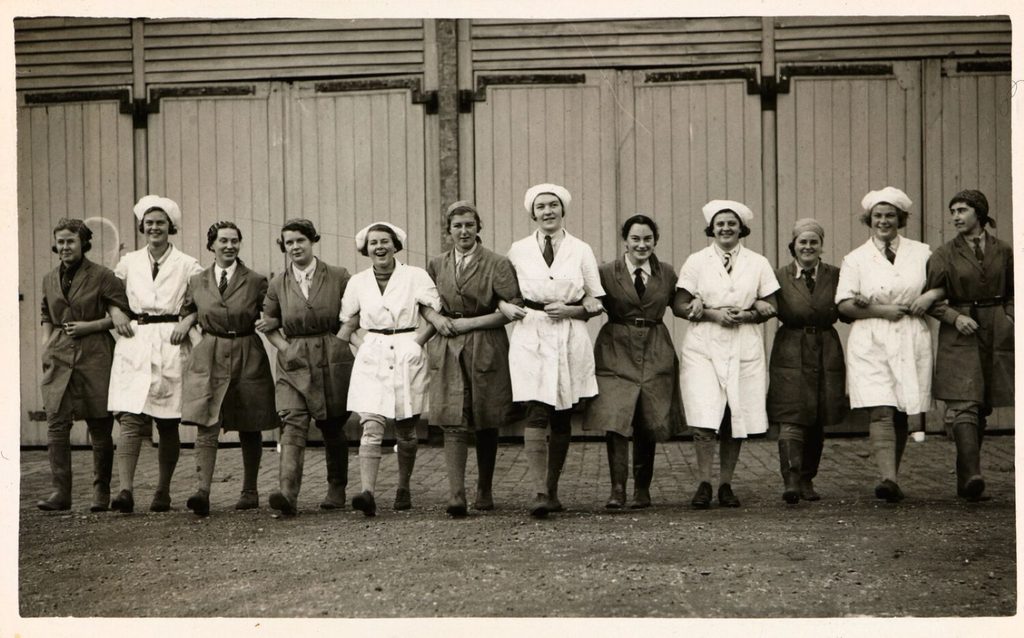
It is perhaps fitting to close with the profile of a fellow librarian. I am proud to be part of their journey, as some of that passion, dedication and curiosity– as testified in these women’s studies, careers and publications– is still felt in the pages of these books, which were in turn owned, read and inscribed by another cohort of women scientists. In our library, they continue to be available for new generations of readers, researchers and historians today, as we remember and share their immense contributions to dairy science.
Bibliography and references
- Thomas Tusser, Fiue hundreth pointes of good husbandrie (London, 1585 and 1672 editions) RESERVE–630.942-TUS
- ‘Technical education for dairymaids’ in The Graphic (October 27, 1892), pages 481-482. MERL LIBRARY RESERVE MID FOLIO–4370-TEC
- Mary Vidal, Edith Cannon : cheese maker (1993) MERL LIBRARY PAMPHLET–4390-BOX 1/39
- K.D. Maddever, Farmhouse cheddarmakers’ manual (Thames Ditton : Milk Marketing Board, 1988) 637.3542-MAD
- Studley Guild, The History of Studley College https://www.studleyguild.org/?page_id=526 [visited on 23.05.2026]
- Edith Bradley and Bertha La Mothe, The lighter branches of agriculture (London : Chapman & Hall, 1903) MERL LIBRARY RESERVE–8220-BRA
- The woman’s agricultural times : a quarterly magazine devoted to the lighter branches of agriculture, rural industries, and country life generally, vol. 5 (Studley : Studley Castle Agricultural Association Limited, 1904) MERL LIBRARY RESERVE–8220-WOM
- ‘Obituary of Emily Kyle Little’, in Reading Standard (22.02.1952)
- Ellen Yeld, Practical cheese-making : for smallholders, farmers, and others. 2nd and 5th editions (Leominster : Orphans Printing Press, 1918 and 1919) MERL LIBRARY–4390-YEL and MERL LIBRARY DC PAMPHLET–4390-BOX 09/53
- Dora G. Saker, Practical cheddar cheese-making (1917) MERL LIBRARY–4390-SAK
- Dora G. Saker, Clean milk for cheese making (London : National Clean Milk Society, 1920). MERL LIBRARY DC Pamphlet–Box 26/1
- Val Cheke & A. Sheppard, Cheese and butter (London : Hart-Davis, 1956) MERL LIBRARY–4390-CHE
- Val Cheke, The story of cheese-making in Britain /(London : Routledge & Kegan Paul, 1959 MERL LIBRARY DAIRY COLL–4390-CHE
- C.W. Walker-Tisdale and T.R. Robinson, Practical buttermaking. 7h ed. / entirely revised and rewritten by Dorothy V. Dearden (London : George Allen & Unwin, 1934) MERL LIBRARY–4390-WAL
- R. Stenhouse Williams & E.C.V. Mattick, Raw milk : its possible importance to the health of the nation (Reading : Reading Pathological Society, 1929) MERL LIBRARY DAIRY PAMP–7060
- E.C.V. Mattick, The biochemistry and bacteriology of discolouration in Stilton cheese (Reading : University of Reading, 1923) MERL LIBRARY DAIRY COLL–4390-MAT
- J.G. Davis & Dora Knight, Cheese. 4 vols (London : J.& A. Churchill, 1965) MERL LIBRARY–4390-DAV