Discovering the Landscape: Dublin of the Future (1922)
-
Author
- Alison Hilton
-
Published Date
- June 23, 2016
<<<<<[caption id="attachment_3867" align="aligncenter" width="550"] Plan of Dublin from Abercrombie’s 1922 ‘Dublin of the future’[/caption]
This post highlights Dublin of the future: new town plan by Patrick Abercrombie, Sydney Kelly and Arthur Kelly (University of Liverpool Press, 1922) – a title from our MERL Library Landscape Institute collections with intriguing context and provenance.
Patrick Abercrombie (1879-1957) was a town planner active in the interwar period. He played a leading role in planning for the redevelopment of a number of urban areas, such as London and Plymouth. Abercrombie retained a love of traditional landscapes and historic towns. His 1926 article ‘The preservation of rural England‘ published in the Town Planning Review led to the foundation of the Council for the Preservation of Rural England (CPRE – of which we hold an archival collection.

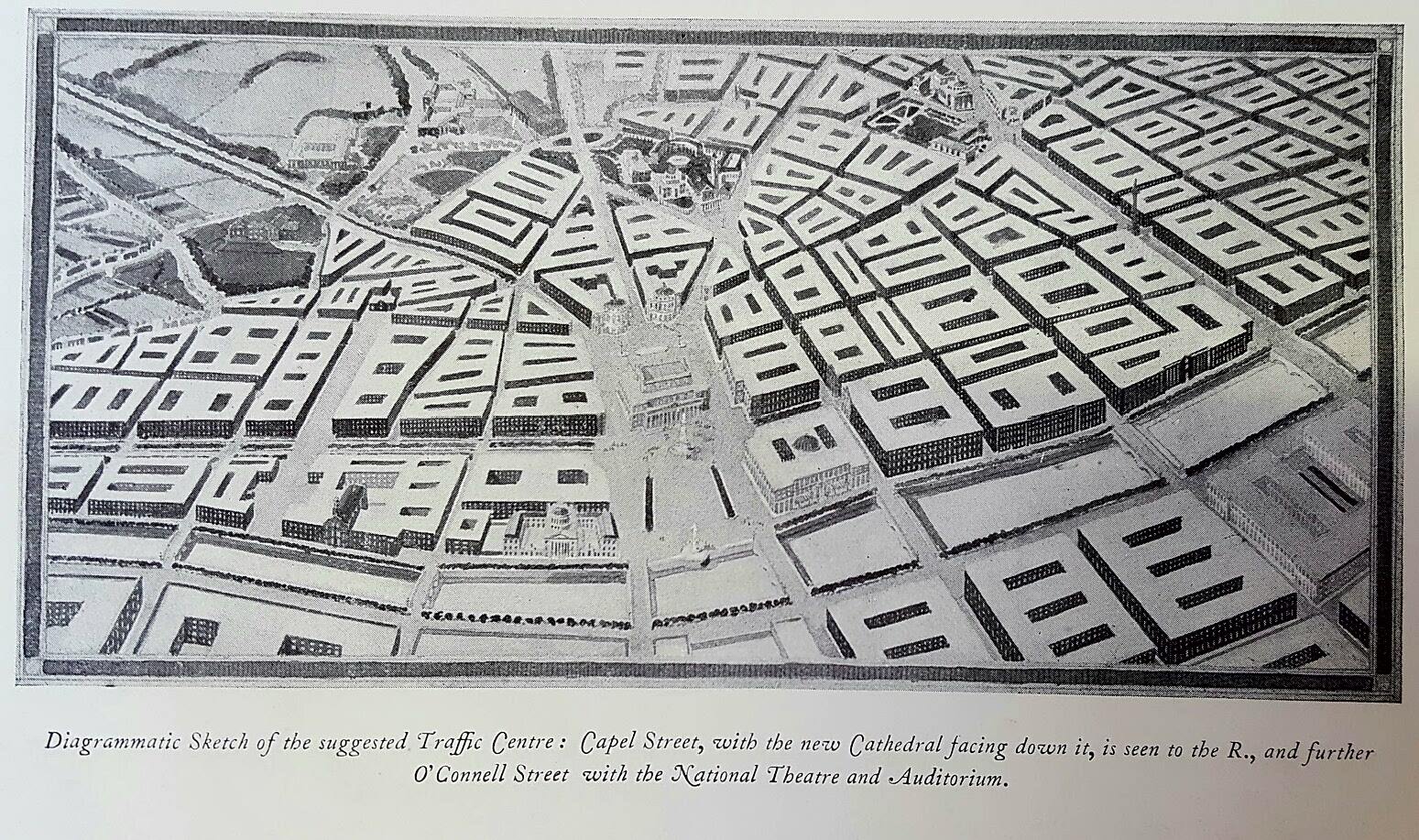
The foreword of Dublin of the future gives us an impression of the impact contemporary events were having on the day to day life of the time. The Civics Institute of Ireland launched a competition in 1914 to encourage plans for a ‘greater Dublin’, to stimulate innovative ideas for how the city might be developed and address its housing shortage. The competition was won by Abercrombie, Sydney and Kelly. The outbreak of World War I in 1914 marked the beginning of several turbulent years for the city. In 1922, Abercrombie returned to his plans for Dublin:
The members of the Institute feel that with the recent change in National circumstances a new epoch has begun, and that the present is a most opportune time to arouse the interest of the Citizens, hence it is that the design and report prepared… in the year 1916, now appears.

Interestingly, the copy of Dublin for the future we received from the Landscape Institute has been inscribed with the signature ‘T. W. Sharp’ on the front endpaper (left).
It seems a fair assumption that this signature belongs to Thomas (Wilfred) Sharp (1901-1978).
Thomas Sharp was a town planner and writer, who we can imagine was was inspired by Abercrombie’s work. Sharp shared Abercrombie’s enthusiasm for the landscape and its protection (he was President of the Landscape Institute, 1949-1951). Coming into his own as a town planner following World War II (working on towns such as Oxford, Exeter and Salisbury) that this is likely to be Sharp’s copy of Dublin is a very rewarding aspect of the provenance of the book.
Upon first opening the book – the reader is presented with a striking and unusual frontispiece (below).
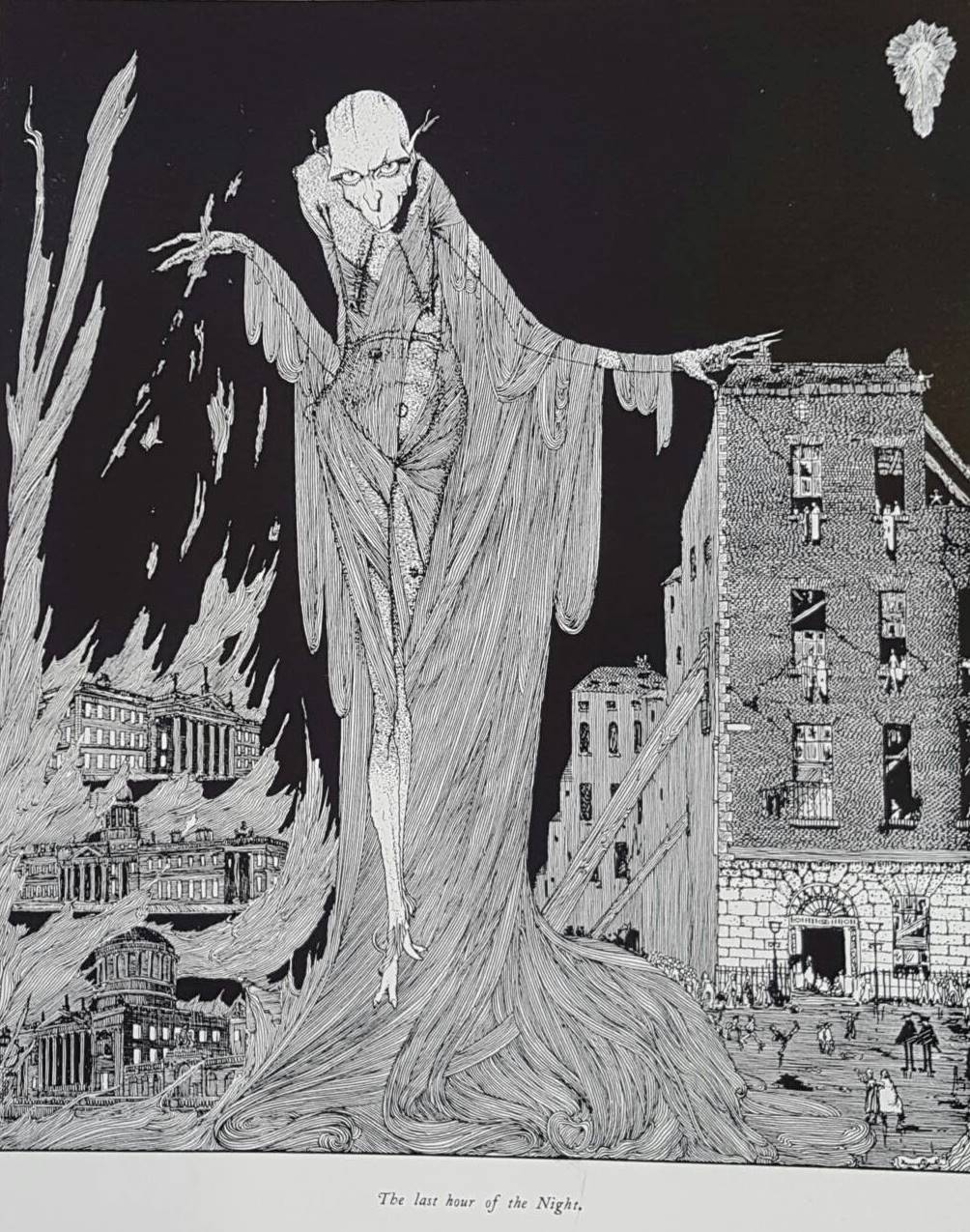
On first inspection – you could almost wonder why this illustration is used as a frontispiece in a publication largely about the technicalities of town planning. Harry Clarke (1889-1931) was born in Dublin and worked as a book illustrator and stained-glass artist. Clarke was also a prominent figure in the Arts and Crafts movement in Ireland.
Clarke’s The last hour of the night makes plain to the reader the damage incurred by the city during the preceding years of war and battles for independence. It is a haunting image that alludes to the challenge faced by Abercrombie and his team to rebuild, redevelop and reinvigorate the city.
Few towns have suffered a change, physical and psychological, during these intervening years of war, trade boom and subsequent depression: but Dublin has added the double tragedy of war and civil war within her gates.
(Dublin of the future, p. ix).
You can see Dublin of the future in full here.
Find our more about our Landscape Institute collections here.
Questions? Then please get in touch with us at merl@reading.ac.uk
Claire Wooldridge: Project Librarian (Landscape Institute)