Shaping the Land – why is the first of our new galleries all about trees?
-
Author
- Alison Hilton
-
Published Date
- November 23, 2016
<<<<Written by Guy Baxter, Archivist
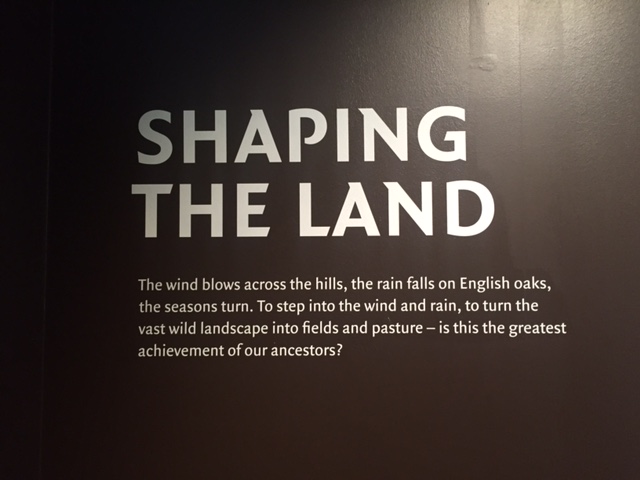
The first space that visitors to the new MERL galleries enter is deceptively simple. It contains one object (a timber carriage), one large picture (an oak tree) and one literary quotation. Thanks to the projected animation and immersive soundscape, visitors can also see and hear the seasons change in the woods.
The gallery was conceived to give visitors the idea of being out in the countryside – after all, the Museum is in the middle of a large town. This is where we hint at the idea of there having been a “natural” environment, before people came along and started “shaping the land”. The theme of woodland reminds us that a greater proportion of England would have been wooded in pre-historic times, and so our ancestors would have faced the massive task of clearing trees in order to grow crops and graze animals.
But the gallery also carries a number of smaller and more subtle messages. Let’s start with the oak tree. Not only is this a powerful symbol of England – it appears on the “English” version of the pound coin after all – but the image chosen is the first photograph ever taken of an oak, by William Henry Fox

Talbot. Of course, his connection to Reading is well known given that he produced The Pencil of Nature, the world’s first photographic book, in the town. His oak tree is shown in the winter, standing strong against the ravages of time. Longevity is another trait of oak trees that suits the context of the gallery: the “timeframe” here is one of centuries not years.
The second idea that we introduce is seasonality. This is done through our animation which effectively shows all four seasons in one day – not such a rare occurrence in England! The animation, made by the Netherlands-based firm ShoSho, shows a woodland and also some land beyond that has been cleared – but with a lone oak in the background as well. In this gallery we introduce the changing seasons in nature partly as a prelude to the next section, A Year on the Farm, which examines how the seasons relate to the food that we grow and eat.
The animals that occasionally appear in the animation include a gall wasp. This was partly inspired by Dr George McGavin’s amazing documentary on oak trees in which he notes not only the symbiosis between the gall wasp and the tree but also the subsequent use of oak gall in the production of ink. So much of what is in our library and archive – indeed so much of our recorded history and knowledge – owes a debt to that relationship between insect and tree.
In front of the animation stands the timber carriage – a large and constant reminder of man’s interaction with the land. The carriage itself, also known as a ‘timber jill’, was used for hauling timber by
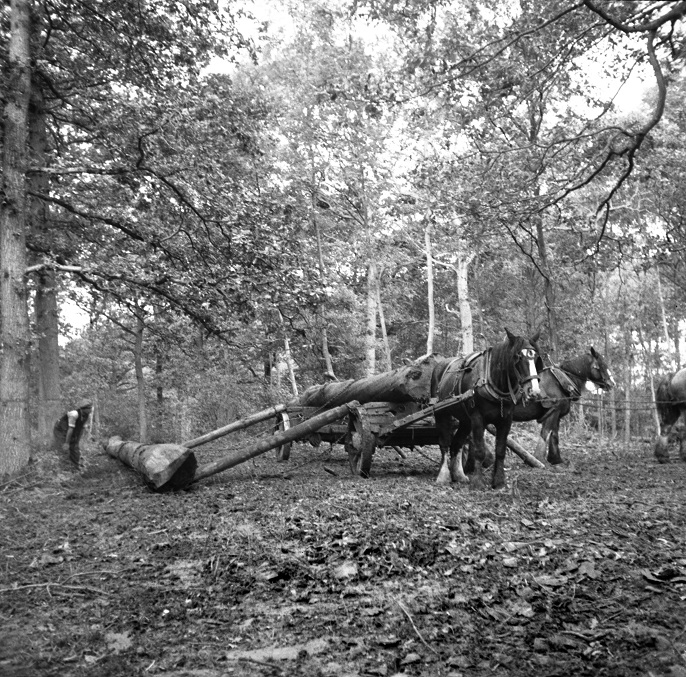
the Hunt Brothers of Waterside Works, a firm of millwrights in Soham, Cambridgeshire. The donor, Mr Tom Hunt, requested that they be recorded as ‘in memory of Thomas B. Hunt, Millwright, of Waterside Works, Soham, Cambs.’ This was his father, who died in 1954 at the age of 95 and was working almost up to the last. It was given to the MERL in 1955 – the year that we opened to the public for the first time – so it’s appropriate that it should be “object number 1 in gallery number 1” as we re-open.
We have also displayed a photograph, from the Miss Wight Collection, to show a similar carriage in use. The photograph was taken around 1935 in Aconbury Woods, Herefordshire.
The quotation, chosen by Dr Paddy Bullard in the Department of English and American Literature, is from the Victorian poet Gerard Manley Hopkins. It comes from his poem Pied Beauty. We also considered another of Hopkins’s poems, Binsey Poplars in which he mourns the felling of trees in 1879;

and we looked at using a section from A Shropshire Lad by A. E. Houseman (verse 31) which describes the same wind blowing through the trees that blew on the Romans many centuries before.
Finally, we added some images of leaves – manipulated by our photographer Laura Bennetto to reflect the style of Fox Talbot’s early leaf photographs. The actual images were provided by the Dr Alastair Culham at the University Herbarium and show the following native English varieties: oak, elm, ash, beech, willow, hawthorn, hazel, elder and apple. The leaf motif has also been used to decorate the new areas of glass in the Museum’s introductory area.
This has been a really fascinating gallery to work on and – because of its seeming simplicity – also quite a challenge. We took inspiration from many places and, made some fascinating discoveries along the way – not least David Hockney’s brilliant Yorkshire Wolds film. It has also been a really collaborative effort and one that has, we hope brought out the best of our creative, technical and curatorial skills.