Research tip #4: Confused by codes?
-
Author
- Alison Hilton
-
Published Date
- February 25, 2014
Confused by codes?
All archives use reference codes to identify their collections, files and individual documents. These are often confusing, even for the archivists, but they are necessary to help us find things quickly and to make sure that items don’t get lost. Sometimes codes are completely meaningless, sometimes they can help to guide you through a collection – for instance document “A/1/1” is usually going to be part of a group of documents called “A/1”.
For the MERL archive there is quite a strict system of codes, which depend on the type of archive being described. When MERL first collected farm records, these had a three-letter code based on the county, e.g. “BER” for Berkshire. Occasionally you will see these codes still, but usually we put the code “FR” on the front of all our farm records, e.g. FR BER 1/1. The other major groupings are TR (for Trade Records), CR (For Co-operative Records), SR (for Society and Association Records), P (for photographic collections – although you’ll find photos in other collections as well) and D (for Documents, including the archives of individuals). Sometimes you’ll come across slight variations, but this scheme covers most of the MERL archive.
Our recent acquisition of the Archives of the Landscape Institute (which you can read about in this post) has led us to introduce a new code, AR (for Architectural Records). This is being used for the records of any architects and landscape architects, whether individuals or businesses. We think this is the first new code for about 15 years – believe it or not, we do try to keep things simple for our users!
If you’re struggling to understand an archive reference number, our enquiries team will be glad to help – merl@reading.ac.uk
By University archivist, Guy Baxter.
-
Author
- lottiewood
-
Published Date
- February 19, 2026
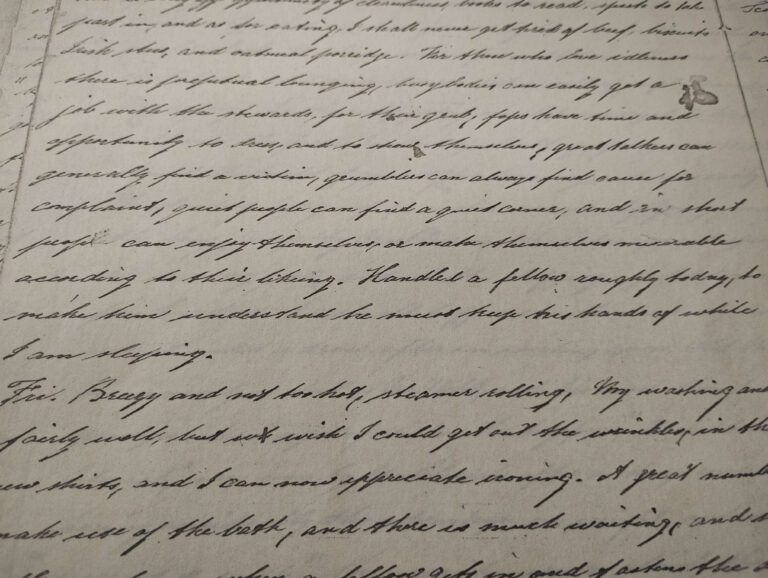
“I am the farm worker going home at evening”: gender fluidity, rural landscapes, and the Women’s Land Army
Library trainee Lottie Wood reflects on gender fluidity in the work of E. M. Barraud, and Barraud’s reflections on her time in the Women’s Land Army