Reading Readers – Hilary Matthews
-
Author
- Alison Hilton
-
Published Date
- February 19, 2016
<<This month, University of Reading PhD student Hilary Matthews tells us about her research into livestock portraiture of the late eighteenth and early nineteenth century.
As a Reading University PhD student, I am looking at how the paintings and prints of livestock in the late eighteenth/early nineteenth century functioned within the society that produced them. My research is centred on the Museum of English Rural Life’s own collection of livestock paintings and I make a weekly 4 ½ hour round trip from my Essex home to work on the museum’s associated archives and agricultural books and ephemera in the Reading Room.
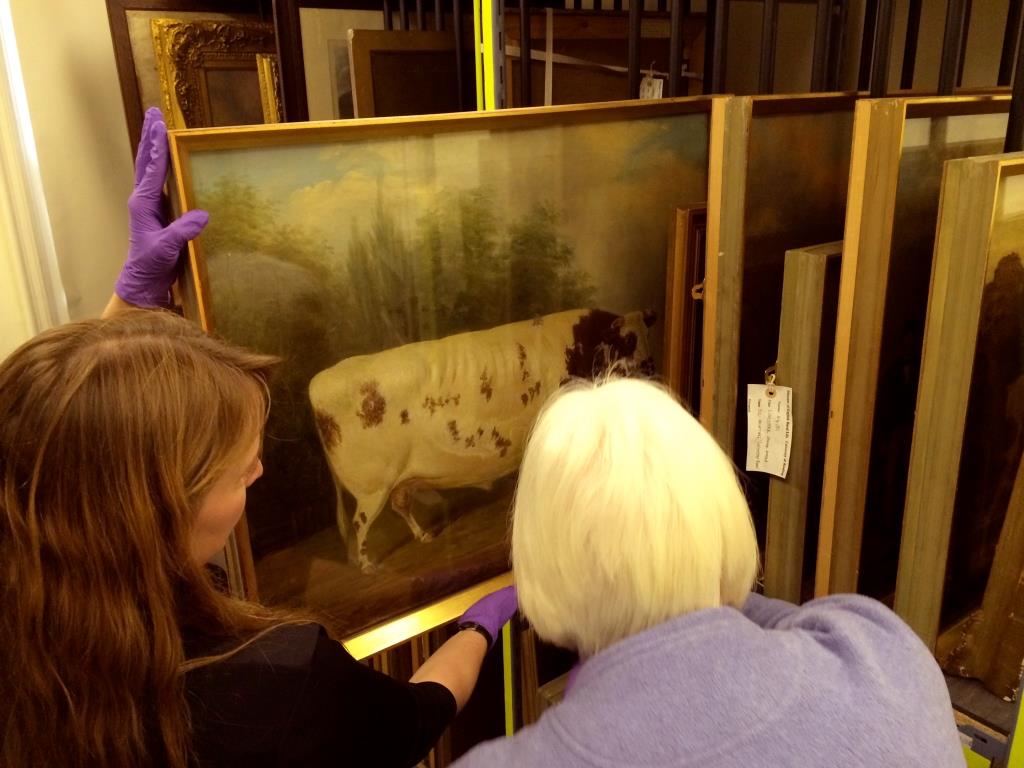
When I explain to people what I am researching the first question is invariably what do the paintings look like and secondly why were they depicted like this? To answer the first I always tell people to close their eyes and visualise portraits of cattle, pigs and sheep with huge bodies, tiny heads and short legs. It’s amazing that when I say this almost everyone goes “oh yes I know what they look like”. The second question, why painters depicted them like this, (although some did depict them more naturally), lies at the heart of my research.
The desire to satisfy the food demands of the rapidly growing urban population made farmers and landowners continually seek to breed animals that would satisfy this demand. My research reveals that in doing this the lines of the strong class system of the period were continually stretched and reshaped as landowners, often without the skill and knowledge to breed the best quality livestock themselves, had to rely on the poorer, but better, livestock breeders to provide them with the best stock. This stretching of the class boundaries does not seem to have applied when patrons commissioned artists to paint their animals though. To immortalise their livestock, the aristocracy seem to have engaged society artists whilst the lowly farmers employed jobbing sign painters. However, as I am discovering in the Museum of English Rural Life’s archives, this was not always the case.
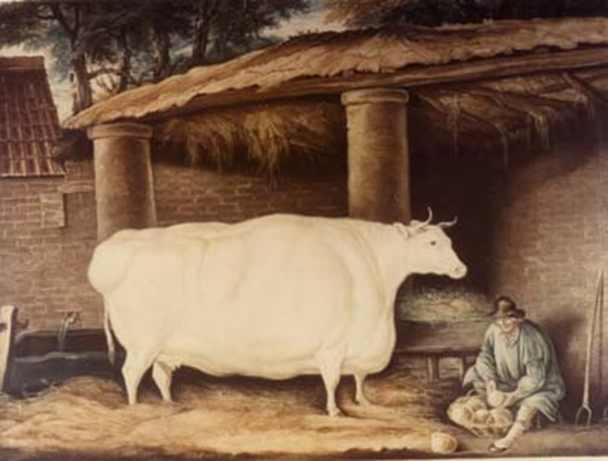
Apart from recently studying art history, I have also studied agriculture and for many years, I have bred, exhibited and judged pedigree livestock. I try to incorporate all these aspects into my research and so, for instance, in trying to understand a painting like Thomas Weaver’s, The White Heifer that Travelled, (below), I have tried not only to appraise this work as an art historian but to look at it scientifically too. A heifer is a young cow that has never calved but even allowing for artistic licence this heifer was obviously huge. Although she could have been born as a freemartin, (a freemartin is a female calf from a set of mixed twins and is invariable infertile), by trawling through the Museum of English Rural Life archives I have learned that she may have been speyed. Around the late 1790s, farmers experimented on female cattle by surgically removing what they quaintly called the ‘lusts’. This stopped female cattle coming into season and allowed them to fatten much quicker. This sort of information helps me to understand the paintings far better – you could almost say that it puts meat onto the bones of my research. However, in this instance I don’t think this particular heifer requires any more meat on its bones!
Find out more about animal portraiture and our collection in this blog post from October 2015 by Art Collections Officer, Jacqueline Winston-Silk.
#ReadingReaders
-
Tags
-
Author
- lottiewood
-
Published Date
- February 19, 2026
“I am the farm worker going home at evening”: gender fluidity, rural landscapes, and the Women’s Land Army
Library trainee Lottie Wood reflects on gender fluidity in the work of E. M. Barraud, and Barraud’s reflections on her time in the Women’s Land Army