My Favourite Object #3: Horse overshoes, or lawn slippers
-
Author
- Alison Hilton
-
Published Date
- August 7, 2013
<written by Claire Smith, Weekend Supervisor/Learning Assistant. To learn more about Claire, see her previous post.
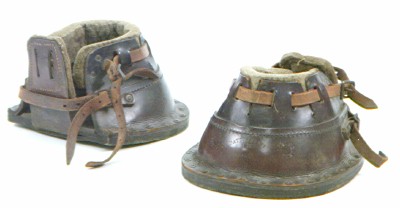
Before the invention of the lawnmower in 1830, grass would be cut with a scythe, or animals would be allowed to graze on the lawn to keep it short. From the 1850s, horse-drawn lawn mowers were introduced. In order to prevent the horse’s hooves from damaging the lawn as the mower was pulled, the horse was fitted with lawn shoes, or slippers. These could also be made to measure for donkeys and ponies. The horse’s feet were simply strapped into the leather overshoe. This spread the pressure of the foot more evenly and prevented the shape of the horseshoe from being imprinted over the lawn.
There are several pairs of lawn shoes in the MERL collection, mainly for horses, but also some smaller ones which were probably used for donkeys or ponies. The pair shown above are made from leather, and padded on the inside with wool. They would have been strapped around the horse’s hooves and fastened with the buckles.
Horses are not the only animals to have shoes – when turkeys made their three month long walk to market, they would wear special leather boots to protect their feet. Pigs would wear knitted boots with leather soles. Geese wouldn’t allow themselves to be shod, so their feet would be dipped in tar and covered with sand. Sadly we don’t have any examples of pig or turkey shoes in the museum, but I think the horse slippers are lovely enough to make up for it!
-
Author
- lottiewood
-
Published Date
- February 19, 2026
“I am the farm worker going home at evening”: gender fluidity, rural landscapes, and the Women’s Land Army
Library trainee Lottie Wood reflects on gender fluidity in the work of E. M. Barraud, and Barraud’s reflections on her time in the Women’s Land Army