MERL and the Great British Sewing Bee
-
Author
- Alison Hilton
-
Published Date
- May 22, 2013
Did you watch the Great British Sewing Bee? I’ll admit that I was sceptical at first, not being a fan of “reality” television, but I have to confess I’ve been glued to every episode, and was delighted to see Ann’s years of experience win her the trophy. As a dressmaker myself, I’ve been very impressed by the wide range of skills demonstrated by each of the participants, and their ability to stay calm under pressure.
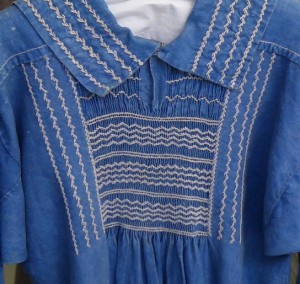
I first became involved at MERL thanks to my passion for sewing. I visited one weekend, and was lucky enough to catch the tail end of a guided tour that took us into one of the museum’s open storage areas, where I was able to see the extent of the smock collection. I wrote a post about it on my own blog, and was contacted by the Assistant Curator who invited me to get involved as a volunteer. A week or so later I found myself working in the museum alongside another volunteer, helping to record the measurements and condition of all of the smocks.
One of the things I found most fascinating was the fact that because most of the museum’s smocks pre-date the domestic sewing machine, they’re almost all made entirely by hand – not only the smocking and embroidery, but also the long, functional seams. When I tried my hand at a bit of smocking for myself, I was surprised by just how slowly the work progressed. You certainly couldn’t run up a smock in the measly four hours allocated to the Sewing Bee finalists to make a modern man’s shirt!
A couple of weeks ago at MERL we were delighted to host a group of visitors from New Stitches Magazine, all of whom had been watching the Sewing Bee with great interest, and were fascinated not only by the range of objects we were able to show them from our textile collections, but also with our sewing machines, which range from domestic models to very specialised industrial equipment. My personal favourites from the objects brought out for the group are the Dorset Buttons – another hand-sewing technique that I tried out after having seen the collections for myself.
It’s four years since my first visit to MERL, where I now work as Learning Assistant and Visitor Services Assistant. My experience volunteering with the smock collection led directly to me volunteering in other areas of the museum that I also found interesting, and now part of my role is to create family craft activities which are inspired by the museum’s collections.
The sewing machines, smocks and other textiles collections are currently housed in our object stores on the mezzanine level at the museum. Currently, the only way to access those collections is to come on a guided tour and ask your tour guide to include the store in your tour, or if you wish to study the collections in more details, to make an appointment with a Curator. It’s a shame they are not currently more accessible, but as part of the Our Country Lives project we’ll be looking at ways that these fascinating collections can be incorporated into the main displays. The more interest there is in them, the more likely this is to happen, so leave a comment & let us know if you’d like to see more of the textile treasures.
So if the Great British Sewing Bee has inspired you to dust off your sewing machine and have a go, why not come and see the MERL smocks? Who knows where it might lead you!