Democracy Day: Parliamentary Firsts
-
Author
- Alison Hilton
-
Published Date
- January 20, 2015
Project Officer, Felicity McWilliams, spotted an opportunity to share some of the research she’s been doing for the new galleries…
Today is BBC Democracy Day, the 750th anniversary of the first ever parliament of elected officials at Westminster. Known as the ‘January Parliament’, it was called in 1265 by the Earl of Leicester, Simon de Montfort. De Montfort’s rebel political movement sought to limit the power of the King and called for the adoption of their ‘Provisions of Oxford’, which brought the common business of the realm under the influence of parliament, to be held three times a year.
There had been parliaments before this date, but what made this one so revolutionary was the inclusion of elected officials from major towns in addition to county knights, barons and senior churchmen. Simon de Montfort is sometimes termed the ‘founder of the Commons’ in recognition of his reforms, and he is honoured on a wall relief in the US House of Representatives. Whilst the January Parliament is considered greatly influential in the emergence of parliamentary democracy, historians have warned against idealisation; whilst de Montfort was clearly motivated strongly by ideological principles, he also sought greater personal power and used the parliament to gather partisan regional support to push through his reforms. De Montfort was eventually defeated by Henry III and his son Edward (to become Edward I) at the Battle of Evesham and the political rebellion largely died with him, but the inclusion of burgesses in parliament became common during the reign of Edward I and eventually led to the modern-day House of Commons. De Montfort’s early role in the development of democracy should not be overlooked, particularly this year, the 800th anniversary of Magna Carta.
Thinking about parliamentarians in relation to the Museum’s collections led me to recall some of the research I’ve been doing for the Our Country Lives re-display. One individual I hope will feature is Joseph Arch. Arch started life as an agricultural labourer in the village of Barford, Warwickshire, getting his first job at the age of nine as a bird-scarer, working 12-hour days for a wage of 4d. a week. By the end of his life he had twice been elected as a member of parliament; he was, in fact, the first agricultural labourer ever to become an MP. The Museum holds a range of objects and archives relating to his life, from mystery plaster casts of his hands and his personal diary to union banners and letters.
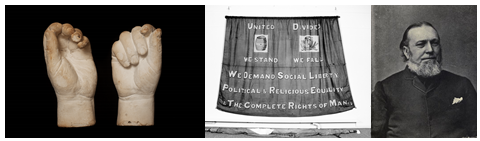
Arch became a registered voter in 1862 upon his father’s death – unlike most labourers he was fortunate enough to own his own home, enabling Arch to qualify for the vote through 40 shilling freeholder franchise. In February 1872, a group of local labourers invited Arch to speak at an event in the nearby village of Wellesbourne and to help them form a union; the venture was successful and led to the formation of the National Agricultural Labourers’ Union, of which Arch became President. Despite early successes, the union eventually collapsed in 1896 but it had been hugely influential. As his biographer put it, ‘after 1872 neither landowner nor farmer could forget that the labourer was a human being – not an ignorant ‘chaw bacon’ or ‘Johnny Raw’ whose views could be dismissed out of hand, but a man prepared, if necessary, to demand the rights and privileges which were his due’.[1] Perhaps there’s something of rebellion and reform in the Warwickshire air; Arch’s Barford is just ten miles from the imposing Kenilworth Castle, once seat of the rebel Earl of Leicester, Simon de Montfort.
[1] Horn, P. 1971. Joseph Arch (1826-1919): The Farm Workers’ Leader. Kineton: The Roundwood Press, p. 219.