Student Spotlight #1: Veterinary Medicine Box
-
Author
- Alison Hilton
-
Published Date
- April 1, 2014
This is the first in a series of blog posts focusing on particular objects, researched by University of Reading Archaeology students as part of their course.
Kelly van Doorn is a second year BA Archaeology and Ancient History student at the University of Reading. On completion of her degree, she hopes to take up a master’s degree in Classics. Following this, she would like to work within a museum, perhaps abroad, so that she can combine her interests in archaeology and ancient history into one job.
The object that I chose to research is a vet’s medicine box from the 18th century, which I chose because I did not know a lot about veterinary care or treatment. I thought that it would be interesting to assess how different medicines from this era were in comparison with a more contemporary period.
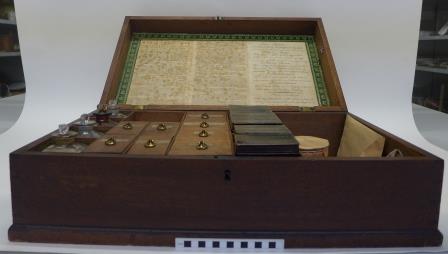
 Before veterinary surgery became a popular and accepted vocation, farmers were often forced to seek help from the blacksmith or it became a ‘do-it-yourself’ job. Medicine boxes needed to be portable and carry all the necessary medicines so that it could be transported to farms. This medicine box was compiled by William Radley, a druggist and chemist in the 18th century. He was in practice from at least 1776, according to an advertisement for his horse medicines in the St. James’ Chronicle, and so it has been estimated that this medicine box is from c.1780. However, Mr William Popplewell, a producer of medicine in the box, is not found as a druggist and chemist until 1822 in Baine’s West Riding Directory, so we are unsure if he was producing medicines before this time, and which casts a bit of doubt on the approximate age of the box.
The medicine box includes: 4 bottles, 4 tin containers, 8 built-in boxes varying in size, and various packets of powders and medicines. Some of these medicines include: diuretic balls used to treat swelled legs or inflammation and prepared by a William Popplewell, pectorae powders used for treating cough or asthma in horses, purging balls for dogs to cool them down or aid in digestion, cordial safe balls to treat a drop of circulation, worm powder and lotion for mange.
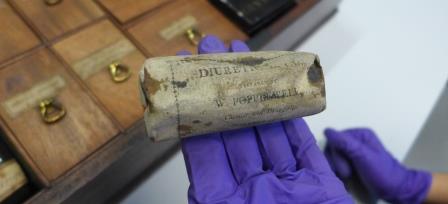
This box was predominantly used for treating horses, although it contains a powder for the ‘cure of mad dog’ produced by a Ms Hill and Berry, most commonly known as rabies. There is also a treatment for Mange, which was, and still is, an ailment which affects horses and causes severe itching and inflammation. It is caused by mites and can be spread between horses easily as well as being passed onto humans, and so mange ointment would be applied to soothe the affected area. It can spread over the horse through grooming, as well as scratching and biting at the affected areas, which would lead to inflammation. The medicine box also contains a few recipes for how to give the correct dosage of medicine or to use the correct ingredients for mixtures. It is unknown how well these particular medicines or medicines in particular from that time worked.

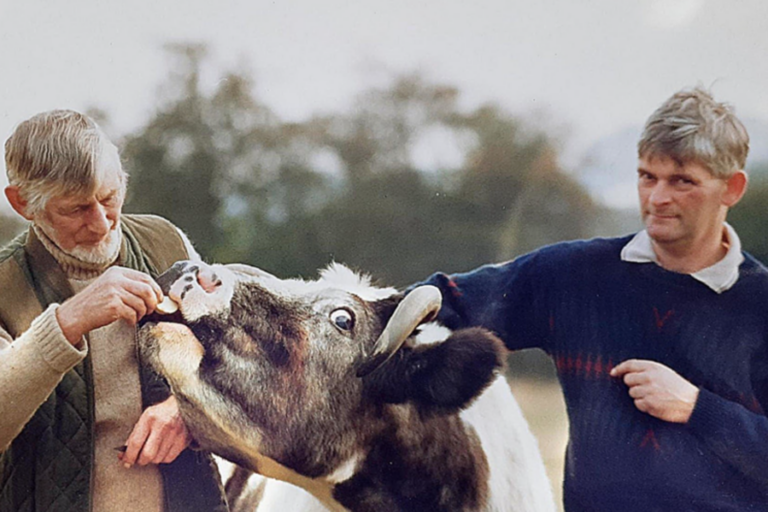
Horse care was not purely medicinal and farmers or stock breeders would use a number of implements to aid in veterinary surgery or applying medicine. A fleam mallet was used to drive a fleam, a 3 bladed implement, into the animal’s jugular so as to bleed it for medicinal purposes. Bleeding was proscribed by doctors and veterinary practitioners alike prior to and during the 18th century. A gag was placed inside the horse’s mouth and forced it open, which prevented the horse from biting. This was used when administering a ball, such as a cordial safe ball, which would be inserted into the back of the throat and would be consumed by the horse. A drenching horn was used to administer liquid medicines to horses and cattle. It would be placed into the animal’s mouth so that the medicine could be poured down the throat.
This box is in very good condition, with the paper and paper wrappings inside demonstrating slight deterioration but nevertheless they are still eligible and useful in teaching us about veterinary care during the 18th to 19th centuries.
-
Author
- Lottie
-
Published Date
- February 19, 2026
“I am the farm worker going home at evening”: gender fluidity, rural landscapes, and the Women’s Land Army
Library trainee Lottie Wood reflects on gender fluidity in the work of E. M. Barraud, and Barraud’s reflections on her time in the Women’s Land Army