
Queer histories in the farm records
For LGBTQ+ History Month, researcher, archivist, and former MERL staff member Tim Jerrome reflects on his experiences of researching queer histories within our farm archives.
-
Author
- Joe
-
Published Date
- February 25, 2026
If you look through one of the many published works exploring queer histories in England, what sort of archival sources might you expect to find?
Court records? Absolutely, given that male homosexuality was illegal until 1967.
Personal papers of well-known LGBTQ+ people? Certainly, as not only do these give details of their everyday lives, but also their friends and queer networks.
Farm records? Not a chance. At least, not until now.
Archives of individual farms were kept predominantly as economic documentation of business outputs. Farm records at The MERL are no different, being originally collected in the 1960s and 1970s as the first comprehensive archive of English agricultural finances.
How, then, can such records be useful for finding queer histories? One thing’s for sure – these histories were not at the forefront of the Museum’s priorities when the collection was compiled over fifty years ago.
Yet some evidence of farming’s social history survives within these farm records, even if unintentionally. When farmers donated a collection to The MERL or left them in wills, they often gave all the papers they could find, including personal diaries and correspondence. It is within these documents that traces of queerness can be found, whether through hints of an author’s sexuality, ruminations on friends and family, or observations about happenings in the local community.
One key source of inspiration was the discovery of Yorkshire farmer Matthew Tomlinson’s ruminations on homosexuality in an 1810 diary. I hoped that, within The MERL archives, I could make a discovery of similar significance. In fact, I did so in the very first week of my research, and have continued to make some further intriguing finds.
Something I find particularly exciting about farm records is their potential for uncovering working class histories. The few queer rural people we know about in my research period (1800-1950) tend to be wealthy individuals owning country estates. I hope my investigative work can possibly redress the balance.
The aim of my research is not only to uncover queer rural histories, but also to offer advice to others seeking to undertake similar projects. Therefore, in this blog, I’ll reflect on some of the lessons I’ve learned whilst using the farm records, so that others (perhaps even you!) can use them more efficiently than I did.
Farm diaries
Running a farm has always required an organised mind. To help with this, many farmers kept diaries. The majority of these journals were purely functional, serving as a reminder of the tasks completed each day. Given the lack of personal reflections, these diaries don’t have much to say about queer histories (though they can tell us about other marginal groups on the farm, such as one 19th century Oxfordshire diary that mentioned women dirt spreading and swede cutting). However, a few diaries are much more detailed, revealing insight into the author’s relationships, as well as accounts of the community which border on gossip.
For the time-savvy researcher, I would recommend giving more attention to items titled “Diary of [farmer name]” rather than those catalogued as a “farm diary”, as the former relates to the person, and people are the core of my research.
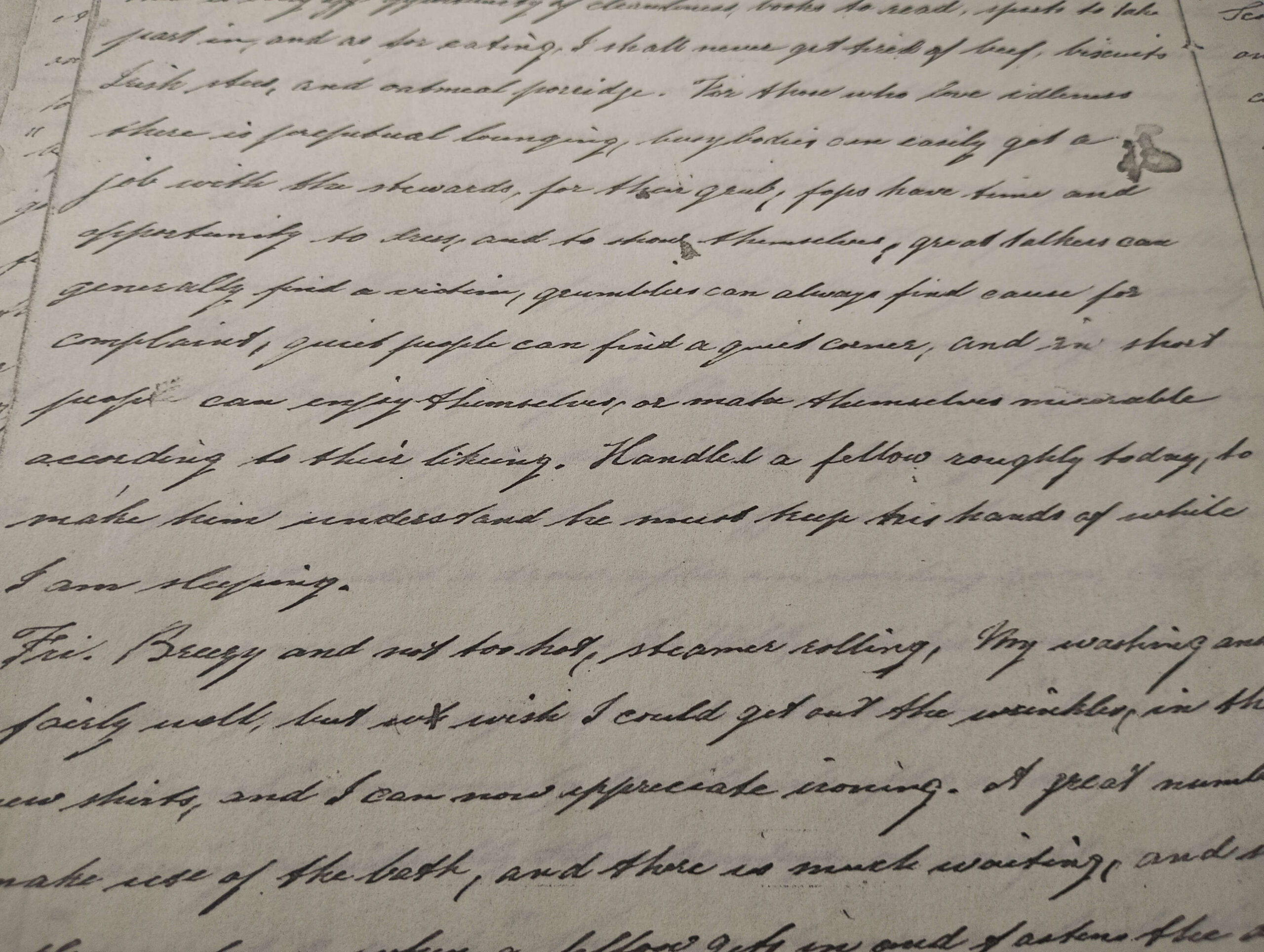
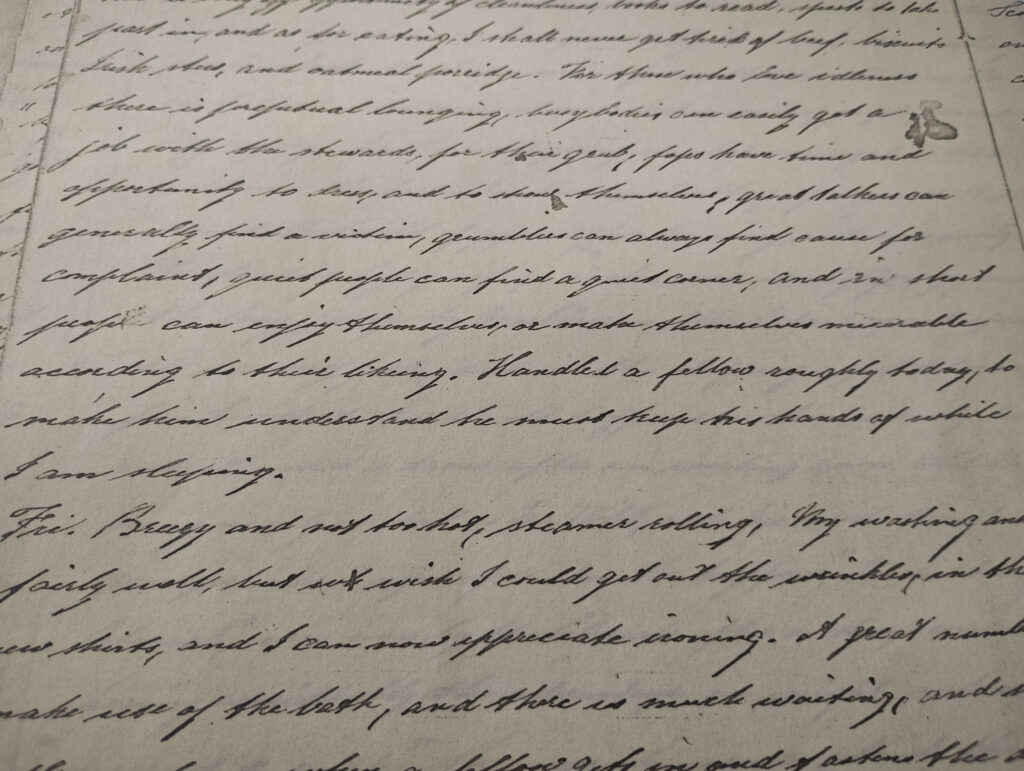
One example of a diary that kept me engaged for several days was that of John Yeo, a Cornish farmer who wrote an account of a voyage to Australia in 1894. Nothing in the diary confirms that John is queer, but several of the comments may suggest something more. Notably, John describes his neighbouring farmer, and writes that “it has been my ambition to make him smile,” and later recalls “I handled a fellow roughly today, to make him understand that he must keep his hands off while I am sleeping.” Taken individually, these comments could mean anything. But by reading an entire diary covering weeks, months, or even years, we can build a bigger picture, which can be invaluable in this line of work.
Correspondence
Useful as farm diaries have been, the majority of my discoveries in the farm records have come from correspondence.
The most significant drawback of diaries – and many other archive collections – is that all the documents have the same author. So, they communicate only one perspective on the world. In contrast, a folder of a farmer’s letters might contain dozens of authors. Given the illegality and moral outrage over homosexuality at the time, few people would have been willing to discuss it in writing. This diversity of voices increases the chances of a mention of LGBTQ+ issues appearing.
Additionally, I’ve found that queer people aren’t particularly likely to discuss their queerness in their own personal writing. But people certainly received intimate correspondence from acquaintances of the same sex, who in some instances were likely same-sex lovers. Sticking with the naval theme of the above diary findings, I uncovered several letters from Vice Admiral Henry Hotham to William Fletcher, a sailor in the Napoleonic Wars who later became a farmer (and thus the letters survive in the farm records). The language in the letters suggests an intense closeness between William and Henry.
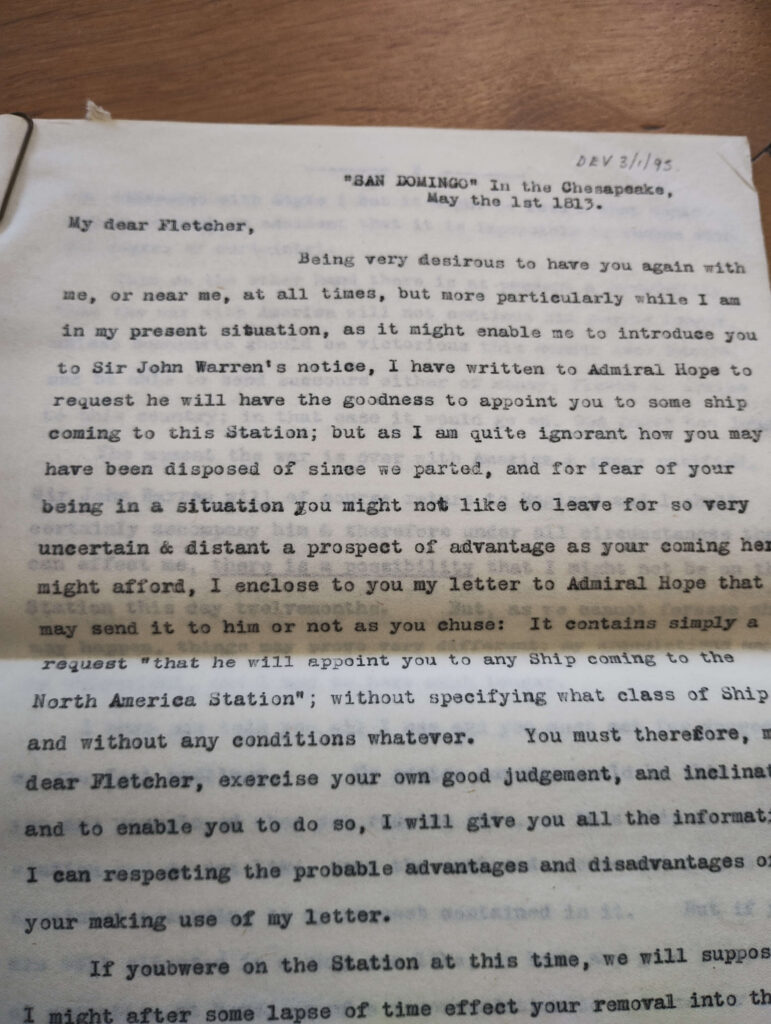
One of many letters that Henry Hotham sent to William Fletcher. This letter opens with the line “Being very desirous to have you again with me, or near me, at all times…” On multiple occasions, Henry writes of trying to arrange for them to serve on the same ship. (MERL FR DEV 3/1/95)
As well as retaining incoming correspondence, farms (like most businesses) also kept letter books recording all outgoing letters as well. These present the same issue as farm diaries; they only speak in only one voice, so if that voice isn’t willing to discuss queerness, you’re out of luck. However, what particularly intrigued me about some letter books was not what I found, but what was missing. Obviously, if you write a letter that you expect to be destroyed by its recipient, then you aren’t going to keep a record in your own letter book. In multiple instances, I found evidence of pages that had been cut out of letter books, which raised questions of why.
Handwriting
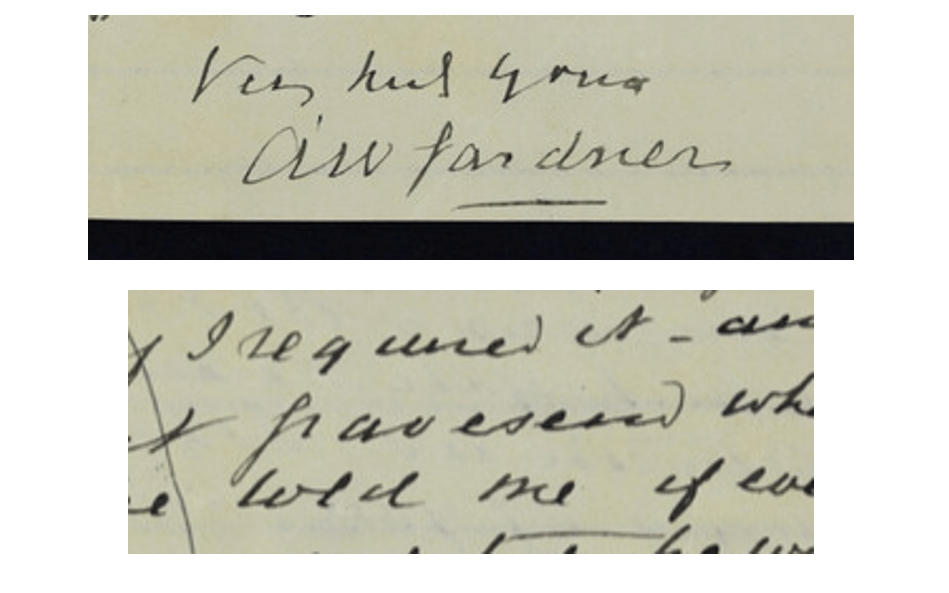
Anyone who works with archival material from the 19th and early 20th century will tell you that the most time-consuming element of this work is decoding difficult handwriting.
I’m trained in palaeography – the study of deciphering old forms of text – but it failed to prepare me for the farm records. You can be taught to read old handwriting, but you can’t really be taught to read bad handwriting! Of course, I can’t really hold this against our Victorian authors, especially writing in diaries meant for their own eyes only.
My advice is to create a bespoke alphabet. I’ve learned that even if someone’s writing is a mess, it will often be a consistent mess, forming letters the same way. If there’s a document you really need to read, find a few words that you can understand, and then use them to create an alphabet for that specific author. You can then use these to decode more complex passages. This method can be very time-consuming but it’s worth it if it helps you read a difficult document that everyone else has dismissed.
Copyright
It isn’t appropriate to go into specific examples here, but it wouldn’t feel right to end this blog without mentioning copyright. It’s the single biggest challenge I’ve faced whilst using the farm records.
To briefly explain: under UK law, the copyright of a letter or diary lasts for the lifetime of the owner plus seventy years. This doesn’t prevent a researcher like me from sharing findings from these archives, but I would need permission from the copyright holder to publish images in any form (including social media).
For more recent archives (such as those from the 20th century), copyright is frequently held by the author’s family. Approaching these family members for copyright permission relating to queer history research is – for a multitude of reasons – something that must be navigated carefully. All I can suggest is that you keep in close contact with the archive, as often they will know the copyright holder and can introduce you. Furthermore, if you’re attached to an academic institution, consult with supervisors or colleagues to decide the best approach.
The future of farm records
I hope these reflections have been of some interest for those of you keen on agricultural history, queer history, or both. Using the farm records at The MERL has been as much a process of learning as of discovery. It would be brilliant if these archives saw greater use, for social history projects or otherwise. I hope that my research shows that traces of queer individuals and couples can be found in almost any type of archive. All archives involve people, and wherever you have histories of people, queer histories inevitably occur.
For more of Tim’s research, follow Tim on Bluesky. For more queer history at The MERL, check out Lottie Wood’s blogpost about the life of E. M. Barraud and Barraud’s experiences of the Women’s Land Army. To learn more about Tim’s research, listen to his two episodes on our podcast, Absolute Units.
-
Author
- Lottie
-
Published Date
- February 19, 2026
“I am the farm worker going home at evening”: gender fluidity, rural landscapes, and the Women’s Land Army
Library trainee Lottie Wood reflects on gender fluidity in the work of E. M. Barraud, and Barraud’s reflections on her time in the Women’s Land Army