Tanya Harrod: Archaic Modernists: Women, Textiles and the Margins of Europe
-
Author
- Alison Hilton
-
Published Date
- March 14, 2017
<
Paddy Bullard reflects on Tanya Harrod’s seminar as part of the Department of English Literature and the MERL speaker series on the ‘Tangible and Intangible Countryside’
Tanya Harrod is the doyenne of modern folk art studies, and the most distinguished historian and critic of craft working in Great Britain today. She is best known as author of the monumental Crafts in Britain in the Twentieth Century (Yale, 1999), and of The Last Sane Man: Michael Cardew, Modern Pots and Colonialism, which won the James Tait Black prize for biography in 2012. Most recently she published a collection of journalism and occasional writing, The Real Thing: Essays on Making in the Modern World (Hyphen Press, 2015). She is a founder-editor of The Journal of Modern Craft, and previously was visiting professor at the Royal College of Art, 2000-2010.

On Tuesday 31 January 2017 Tanya came to MERL to give a paper on ‘Archaic Modernists: Women, Textiles and the Margins of Europe’. Tanya’s research focused on a group of ‘erudite, rather intrepid women’ who brought a huge charge of invention, spontaneity and ambition to British textile design during the 1920s and 1930s. They included Phyllis Barron (1890-1964) and Dorothy Larcher (1884-1952), who together led a revival in hand-block printing in England, and their sometime employee Enid Marx (1902-1998) and her partner Margaret Lambert, designers whose collection of ephemeral and vernacular art was put on display at Compton Verney House in 2004.
Tanya argued that these women and others in their circle were united by a determination to find a principle of progress for their craft – textile manufacture – in the ‘living vernacular’ of small scale rural manufacturers. These artists were progressive, modernistic thinkers, quite distinct from the ruralists and proto-organicists (she mentioned MERL favourite H.J. Massingham among others) of their day. Above all, they felt that the British countryside was exhausted as a source for their new designs, because truly local and vernacular traditions of textile design had been so long superseded by machine-led designs and processes. So these women looked much further afield. Tanya’s paper was at its most revealing as she described their undaunted travels and discoveries in some of the remoter corners of western Europe and the Balkans. As she summed her discoveries, ‘abroad was their deep country’.
-
Author
- lottiewood
-
Published Date
- February 19, 2026
“I am the farm worker going home at evening”: gender fluidity, rural landscapes, and the Women’s Land Army
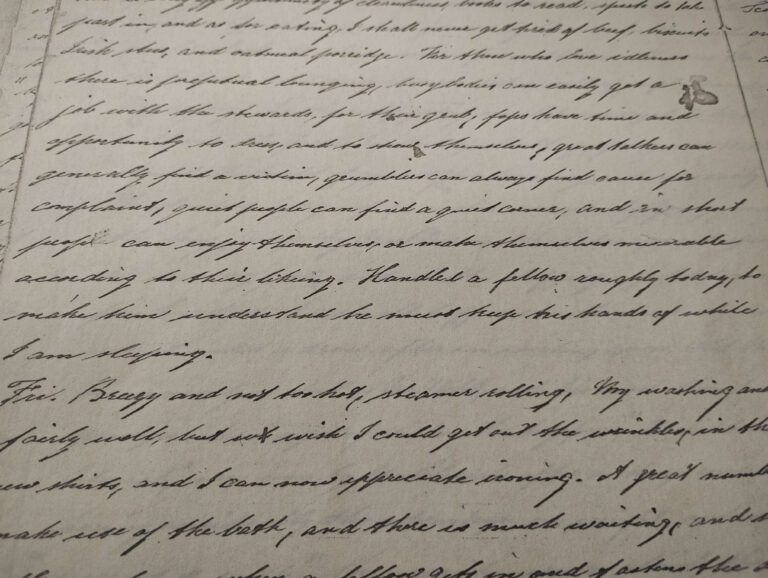
Library trainee Lottie Wood reflects on gender fluidity in the work of E. M. Barraud, and Barraud’s reflections on her time in the Women’s Land Army