Student Spotlight #4: Joseph Arch hand casts
-
Author
- Alison Hilton
-
Published Date
- April 10, 2014
<<Maria Rabbani is a 2nd year Archaeology student at the University of Reading.
The objects which I have chosen are the white plaster casts of Joseph Arch’s right and left hand. The length of the casts is 18cm and their breadth (across the knuckles) is 12cm. His hands look small and delicate, which may be because of the plaster (which smooths roughness), making them look less real. Even though the use of plaster cast has declined nowadays, largely due to photography and film, it is still used by some artists.
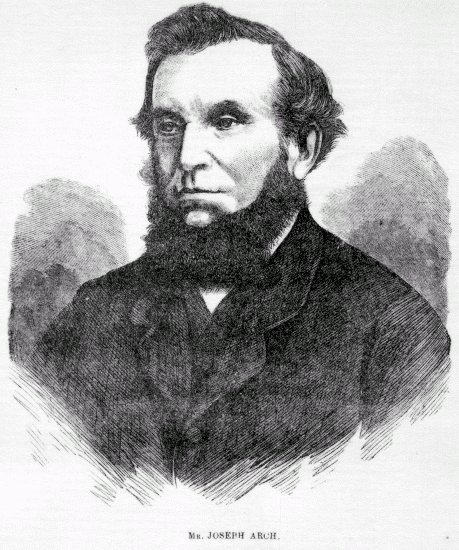
Joseph Arch (1826-1919) was the leader of the National Agricultural Labourers Union (1872-1892), which was the first successful union to be established. Born in 1826 in Barford, Warwickshire, he worked from the age of 25 as a farm worker. At the age of 55 in 1851 he became the President of the Farm Workers Union and became the first labourer to become a Member of Parliament when he was 59 years old.

Prior to the forming of the National Agricultural Labourers Union, the agricultural labourer faced many difficulties such as underpayment, malnutrition and little to no education. While the condition of workmen in other industries improved, the condition of agricultural labourer remained the same. This discontent led to the establishment of the Union which helped to improve the conditions of the agricultural labourer such as gaining the right to vote and so become a free man. The union, which started with small numbers, eventually became a successful union with its peak in membership totalling 86,214 in 1874, mostly due to Arch’s leadership and inspiring speeches which encouraged people to join the union.
The union, although it collapsed in 1896, was resurrected as the National Union of Agricultural and Allied Workers in 1906, which represented farmworkers until 1982. After merging with other unions, over time, it eventually formed the Unite the Union in 2007.
Unfortunately nothing is known about the casting process except that the plaster cast hands were made during the last quarter of the 19th century. Due to the fact that the plaster cast hands do not look not like the hands of an agricultural labourer, which are heavy, calloused and weather-beaten, this indicates that these casts were made when Joseph Arch was no longer a practising labourer but when he started working as a representative of labourers (Sayer 2013).
The exact reason why the casts were made is unknown but maybe they were part of a statue. Even though no other parts of the statue were found, and the fact that he is not holding any tool of his trade in his hand, I do not think this provides enough evidence to claim that these hands were not made to become part of a statue. I think that the way the plaster hands are portrayed resemble hands when they are used to write something. Therefore, it could be possible that it was thought to make a statue of Joseph Arch where he wrote one of his inspiring speeches. Maybe it was intended to add any tool such as a pen after the sculpture was finished. It may be possible that for some unknown reason the production was stopped.
Another possibility as to why these plaster casts were created could be explained by the increasing interest in publicly displaying plaster casts during the 19th century in England to improve art and architecture as well as use them for teaching and research. However, as there is no written record which could explain why these plaster cast hands were created, only speculations can be made.
-
Author
- lottiewood
-
Published Date
- February 19, 2026
“I am the farm worker going home at evening”: gender fluidity, rural landscapes, and the Women’s Land Army
Library trainee Lottie Wood reflects on gender fluidity in the work of E. M. Barraud, and Barraud’s reflections on her time in the Women’s Land Army