Reading Readers – Alex Bowmer
-
Author
- Alison Hilton
-
Published Date
- April 22, 2016
<<<For this month’s Reading Readers blog, PhD student Alex Bowmer gives us an insight into how the MERL archives and object collections are playing a part into his research of livestock health.

As a collaborative doctoral awarded PhD candidate, I split my time between King’s College London and here at The Museum of English Rural Life. The aim of my project is to produce a history ‘from below’ of livestock health in Britain, c1920-70. Departing from the usual historical focus on government policy and scientific experts, it aims to understand what disease meant to livestock owners and how they coped with it at a time of rapid transition in pharmaceuticals and farming systems. Traversing fields, fells, farm-yards and factory farms, it will explore farmers’ changing experiences and interpretations of disease. It will also analyse their uses of family remedies, patent medicines, modern pharmaceuticals and animal management for the purposes of disease prevention and control. As part of my research I want to answer how did these coping strategies change over time, and what factors influenced farmers’ decision-making? How did access to medical information alter disease conceptualisation? and How did attitudes to innovation affect pharmaceutical reach?
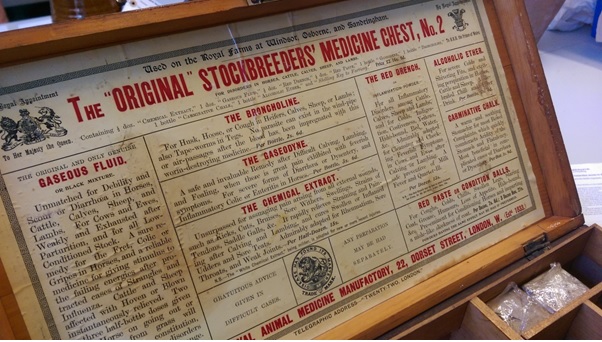
The box contains various medicines used for treating animals on Royal farms at Windsor, Osborne and Sandringham up to 1937.
Over the past few months I have been using both object and archive collections to further develop an understanding of how livestock owners conceptualised disease. On my first visit to MERL I was tasked with investigating and explaining the veterinary medicine collection currently held at the Museum. Some were rather dangerous to say the least! But others have generated new ideas for my research, as many human medicines appeared in a medicine chest given to me for analysis.
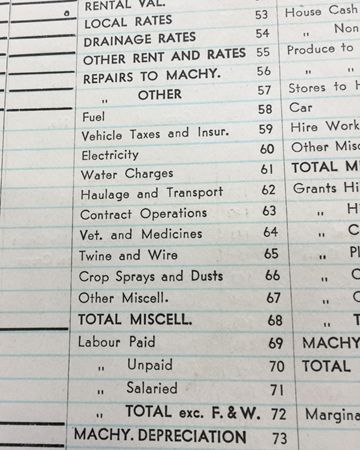
Over the past few weeks I have been travelling across from London to investigate the Farm Management Survey (FMS). The FMS was financed by the Government through the Department for Environment, Food and Rural Affairs (Defra) and undertaken by universities and colleges in England, Wales and Scotland and the Department of Agriculture in Northern Ireland. Beginning in 1936 and renamed in 1986, the survey was voluntary and concerned the collection of financial information of over 500 farms. I have been assessing the veterinary and medical expenditure of these farms to understand whether or not it increased with the advent of new pharmaceutical and chemical medicines made available to livestock owners. Over the coming months I am going to be situated in the reading room, using the vast collections of veterinary and public health texts in MERL’s collection, to begin to write my first chapter understanding how exposure, or lack of, to veterinary knowledge altered how livestock owners tackled concerning disease rates.
Find out more about the MERL collections here. Our reading room is open to the public and you can find more details about accessing the wealth of MERL collections here.
-
Tags
-
Author
- lottiewood
-
Published Date
- February 19, 2026
“I am the farm worker going home at evening”: gender fluidity, rural landscapes, and the Women’s Land Army
Library trainee Lottie Wood reflects on gender fluidity in the work of E. M. Barraud, and Barraud’s reflections on her time in the Women’s Land Army